

Math


Third Edition-Crescent Beach Publishing
Introduction
Mathematics is arguably one of the most prominent and difficult subjects students will encounter. A subject as vast as infinity; it includes Algebra, Calculus, Geometry, Statistics, Number Theory, Topology, and Logic. Through studying mathematics, students gain essential skills for solving problems in life alongside contributing to an ever-changing world. Furthermore, the BC curriculum also incorporates the First Peoples’ Principle to help diverse student perspectives and strategies toward solving problems. Math isn’t just revolving around numbers and symbols; it can help us build connections, communicate, visualize, and reason. Incorporating all these aspects is part of effective problem-solving. These skills are further used in analyzing from different perspectives, considering different solutions, and evaluating effectiveness. When developed early on, mathematical skills help us identify the math around us and build confidence against their fearful existence. Through observing, learning, and practicing mathematics, we enable ourselves to a deeper understanding of the world. An example can be through games and puzzles, our mind actively records every move to ultimately achieve set goals, building a reward and self-motivating system. Whether students choose to pursue a deeper or broader study in mathematics, the design of the Mathematics curriculum ensures that they can pursue their individual interests and passions while establishing a strong mathematical foundation.
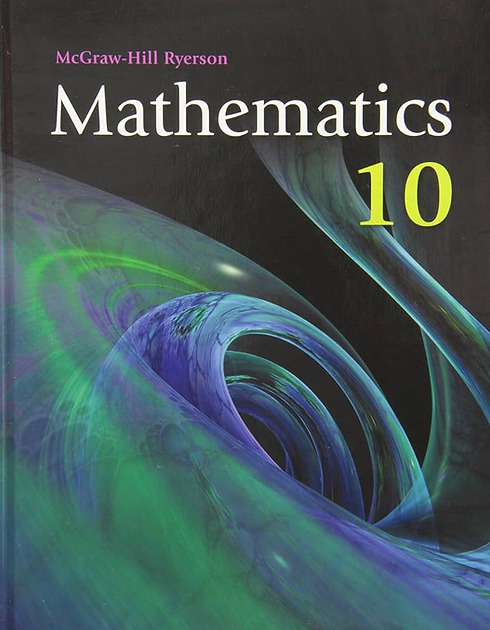
2010 Edition-McGraw Hill School Indigen
Curriculum
This course combines mathematical knowledge with curricular competencies in problem solving, reflection, and communication. It emphasizes both pure mathematics and applied mathematics. The core curriculum includes number operations, algebra, arithmetic sequences, linear functions, trigonometry, data analysis, and financial literacy. Through these areas of study, students are encouraged to think critically, justify their reasoning, and communicate mathematical ideas effectively.
Mathematical Big Ideas:
-
Algebra allows us to generalize relationships through abstract thinking.
-
The meanings of, and connections between, each operation extend to powers and polynomials.
-
Constant rate of change is an essential attribute of linear relations and has meaning in different representations and contexts.
-
Trigonometry involves using proportional reasoning to solve indirect measurement problems.
-
Representing and analyzing situations allows us to notice and wonder about relationships.

Application
Mathematicians develop multiple skills, some of them can be logical thinking, analyzing statistics, and making hypotheses and applying them to solve real-world problems. With these skills, they can build machines and computers, such as phones that we use everyday, or software, such as AI and apps that we rely on for communication and questions. Their importance has been further strengthened during our latest tech boom–the AI or LLM bubbles–where everyone is hoping and betting on AI to be our express ticket to achieving super intelligence, a being that surpasses humans in every way, exponentially advancing our technologies to achieve once believed “impossible” goals.
Theatrical release poster
