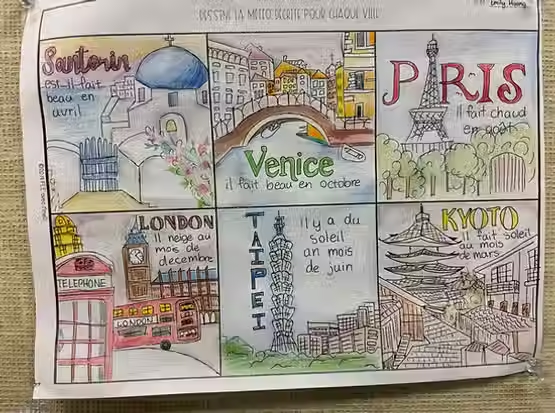
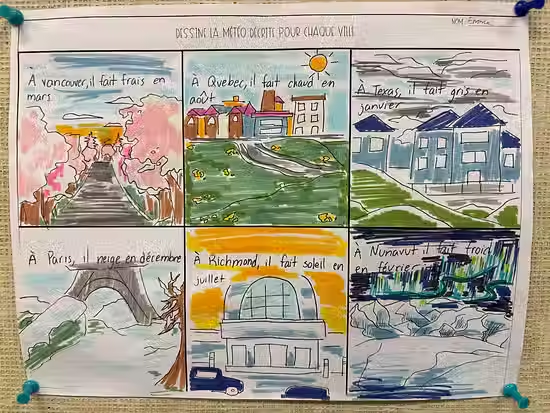
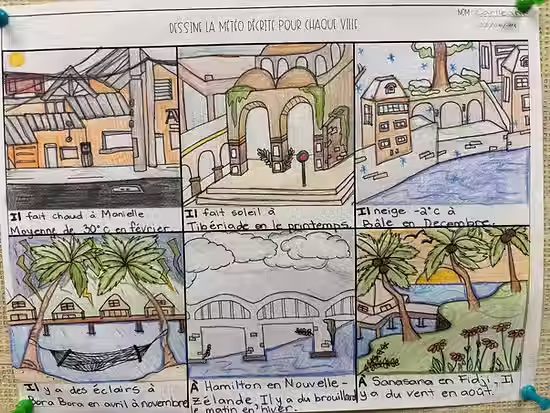
French raw material
Teacher's Interview (Ms.Chen)
1. What career opportunities can students expect by taking French?
Students can access many government-related careers, including engineering, healthcare, environmental fields, and public services such as airports and the postal system. Being bilingual in Canada’s two official languages also strengthens a résumé and increases employability.
2. What does a typical French lesson look like in your class?
Lessons usually begin with grammar instruction. This is followed by interactive class activities where students are required to speak only French for a set period, often based on specific themes. Worksheets are also used so the teacher can provide targeted help when needed.
3. What do you find most interesting about French?
French exposes students to a different culture that still exists within Canada. It also allows learners to master a completely new language with distinct grammar rules and pronunciation compared to English.
4. What do students struggle with the most, and what do they find easier?
Students most often struggle with grammar because it differs significantly from English and is used frequently. Vocabulary is generally easier, especially when words are similar to English. Certain verb tenses, including the future tense that connects to English structures, are also understood more easily.
5. Are there any French learning techniques you recommend? How effective are they?
Recommended techniques include setting aside time to engage with French outside of class through apps like Duolingo, watching French movies or TV shows (dubbed or subtitled), reading books, listening to French music, journaling in French, and practicing speaking with friends. Duolingo is particularly effective because it offers daily reminders, social features, and easy accessibility.
6. Why does Canada speak both English and French, and why isn’t French widely spoken elsewhere?
Canada is bilingual due to historical colonization by both French and English settlers, with the French arriving first but the English gaining greater control. English later became dominant globally. French is also spoken in parts of Africa as a result of French colonization, though it remains concentrated in specific regions outside Europe and Canada.
Curriculum
This course places an equal emphasis on speaking and written production skills. Students will explore grammar tenses and verbs in more depth, with a focus on building proficiency of the past, present and future tenses. In-class French speaking activities will inspire students through immersive learning and develop confidence in expressing oneself in French. Presentations and projects will provide a practical level of French as communication with opportunities to explore creative ways to demonstrate learning, such as through theatre, script-writing, and music-related projects.
Big Ideas:
-
Listening and viewing with intent supports our acquisition and understanding of French.
-
Expressing ourselves and engaging in conversation in French involves courage, risk taking, and perseverance.
-
Acquiring a new language can shape our perspective and identity.
-
Cultural expression can take many different forms.
-
Acquiring French allows us to interact with the Francophone world.
-
Acquiring French allows us to explore diverse opportunities.
Student's interview
Q: What made you study French?
A: Because French is the secondary language of Canada
Q: What was the highest score you had on an assignment, quiz, or test?
A: My final mark was 90%
Q: What was the most difficult part of the course?
A: Assignments, but I enjoy challenging myself.
Q: What was the most enjoyable part of the course?
A: I like to watch French movies.
Q: Why do you think studying French is important?
A: It's one of the most used languages across the world.
Q: Will you continue learning French throughout high school and university or college?
A: Yes.
Q: If you could change one thing about the French 10 curriculum, what would it be?
A: I would've liked it more if the order of the contents changed.
Club's interview
Q: What group of people is French Club intended for?
A: French Club welcomes people of all skill levels, including beginners.
Q: What is the purpose of French Club?
A: Our goal is to promote the diversity of francophone culture, and language.
Q: How will French Club be of any support to students learning French?
A: In French Club, students will be participating in discussions, presentations, and games.
Q: What kind of games does French Club host?
A: Jeopardy, Kahoot, and movie nights.
Teacher's Interview (Mr.Amega)
Q1: What is teaching French like?
A: Teaching French is similar to teaching other subjects. Teachers have to use different strategies to help everyone understand, which can sometimes be challenging.
Q2: How long do you plan to continue teaching French?
A: I plan to finish my career as a French teacher.
Q3: About how many more years will you teach French?
A: I can teach French for about another 15 years.
Q4: What job would you have if you didn’t speak French?
A: I would maybe like to be a lawyer.
Teacher's Interview (Ms.Vrain)
Q1: When did you become a certified teacher and start teaching?
A: I graduated and received my teacher certification in December 2022. After that, I began teaching.
Q2: Why did you choose to be a French teacher?
A: I chose to be a French teacher because I was born in France. Even though my mother speaks English and I went to school in English, I like French. It comes naturally to me, it’s enjoyable, and I really like helping other people learn.
Q3: What do you find difficult about French?
A: It’s not the French language that is difficult, but the job of teaching itself. Especially in the first and second years, new teachers have much more work. You often stay after school and put in many extra hours.
Q4: What was your first language—French or English?
A: French was my first language. I learned it as a baby in France. However, my family later moved to the United States, and I went to an English daycare. I eventually forgot my French and grew up mostly speaking English. When I went to university, I decided I wanted to reconnect with French.
Q5: What would your job be if you didn’t teach French?
A: Teaching French is a big part of my identity, so it’s hard to imagine not doing it. If I didn’t teach, I might work for the government or possibly for a non-profit organization.