Chemistry raw material
Teacher's Interview (Ms.Chen, room 115)
Q1. What is the main focus of the chemistry unit?
A. Students will learn Lewis dot structures, balancing equations, and predicting products from reactants.
Q2. How will students stay safe while working?
A. They will learn laboratory safety procedures, first-aid locations, and how to protect and support one another before conducting experiments.
Q3. How do you ensure a positive classroom environment?
A. By encouraging partner work, class discussions, and collaborative activities so students can support each other while learning.
Q4. How do you handle classroom disruptions or conflicts?
A. Students are expected to self-manage, but if needed, conflicts are addressed privately and resolved through conversation.
Q5. How do you assess student understanding and give feedback?
A. Through class questions, review booklets, instructional videos, quizzes before tests, and PLT sessions where students can ask questions.
Q6. What is your approach to building strong relationships with students, parents, and colleagues?
A. By being genuine, learning students’ interests and personalities, and maintaining friendly communication with parents.
Q7. How do you handle conflicts or disagreements with students or colleagues?
A. By approaching issues respectfully, staying calm, and working toward a shared solution.
Q8. How would you help a student struggling with a chemistry concept?
A. Checking in during class, encouraging PLT visits for one-on-one help, and offering email support for additional questions.
Q9. Are there fun activities students can look forward to?
A. Yes. Students complete assignments related to their own experiences and finish the course with a space unit and personalized projects.
Q10. What inspired you to become a chemistry teacher?
A. Chemistry has always been her favorite science. She enjoys watching students solve problems, experience moments of understanding, and develop interest in science.
Student's interview(Aliza Khan Gr10)
1.What was your first impression of chemistry?
its very complicated once you indulge into the course
2.What's the coolest experiment you've done so far?
making volcanoes with baking soda and vinegar to demonstrate acid base reactions
3.What's one thing in chemistry that you find tricky or confusing?
balancing equations
4..How has studying chemistry changed the way you see things in your daily life?
it changed the way that i believe everything works
5.What's one piece of advice you'd give to a student who is about to start chemistry?
pay VERY close attention towards class discussions
Curriculum
This course continues the development of scientific skills, knowledge and thinking abilities previously explored in Science 8 and 9. Laboratory activities emphasize the scientific approach to problem solving and the importance of scientific observations and interpretation. Big ideas specifically include: Genes as the foundation for the diversity of living things, energy is conserved and its transformation can affect living things and the environment, chemical processes require energy change as atoms are rearranged; and the formation of the universe can be explained by the big bang theory. The ultimate goal of the course is to help develop individuals who are aware, informed and concerned about the physical world.
Teacher's Interview (Ms.Yun)
Q: What core concepts or skills in chemistry are most valuable?
A: Lab skills such as handling chemicals, using equipment (scales, chromatography tools), and performing procedures. Conceptually, understanding that everything is made of chemicals and how elements combine to form materials in the world
.Q: How does chemistry relate to real-world situations?
A: Chemistry is involved in everything—from engineering materials to biochemistry in the human body. It supports innovations in technology, medicine, and other fields
.Q: What projects do students complete, and what is their purpose?
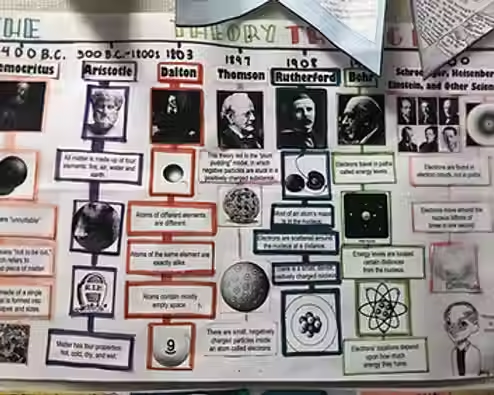
A: Students do beginner labs such as diffusion and density labs to understand matter. They also complete projects on the history of elements and atomic theory to learn how models of the atom developed over time.
Q: How can this subject benefit students in the future (e.g., university)?
A: Chemistry helps students understand chemicals they encounter daily, including medicines and cleaning solutions, and prepares them for science-related fields.
Q: What concepts do students find most challenging, and how do you help them?
A: Students struggle with visualizing small particles, building models, drawing Bohr and Lewis diagrams, and naming compounds. Strategies include modeling, practice, and connecting concepts together.
Q: What is your teaching style like?
A: Inquiry-based, with many questions, demonstrations, videos, and varied activities to support different learning styles.
Q: What part of chemistry do students enjoy the most?
A: Labs and demonstrations, especially visually exciting ones like fire color demos.
Q: How many students are typically in a class?
A: About 20–30 students.
Q: What safety protocols must students follow?
A: Wear PPE (lab coat, goggles, closed shoes, tied hair), use gloves when needed, and know how to handle fires using extinguishers, blankets, or sand.
Q: What is a common misconception students have about chemistry?
A: That chemistry is overly technical or only memorization-based. In reality, it is accessible and can be enjoyed through hands-on labs and exploration.
Teacher's Interview (Ms.Dulay)
Q: What core concepts or skills are most valuable in this subject?
A: Using models (such as Bohr models) to represent atoms and compounds, and identifying elements, compounds, and mixtures in real life.
Q: How does this subject relate to real-world situations?
A: Chemistry explains how all matter behaves, since atoms make up everything. Real-world examples include reactions and how temperature affects particles, such as bridges expanding in summer and shrinking in winter.
Q: What project do students complete, and what is its purpose?
A: Students research an element and create a project cube showing its history, properties, uses, and a Bohr model.
Q: How can this subject benefit students in the future or in university?
A: It supports careers in medical fields, research, and teaching. Universities often require science courses up to Grade 11. Skills like questioning, using the scientific method, and organizing reports apply broadly.
Q: What concepts do students find most challenging, and how do you help them?
A: Students struggle with naming different types of compounds. She uses tables that require students to identify the compound type before naming it.
Q: What is your teaching style like?
A: She uses familiar, real-world examples to make content relatable. Homework is assigned as essential practice.
Q: What part of chemistry do students enjoy most?
A: Labs—mixing compounds, using lab equipment, and observing physical or chemical changes.
Q: How many students are typically in a class?
A: Usually the high 20s.
Q: What safety protocols must students follow in chemistry?
A: Wear a buttoned lab coat, goggles, tied-back long hair, full-length pants, and closed-toe shoes.
Q: What is a common misconception students have about chemistry?
A: That the class involves explosions or dramatic chemical reactions.
Student's interview(Frank Xu Gr10)
1.What was your first impression of chemistry?
I find chemistry very interesting and how the characteristics of atoms work
2. What's the coolest experiment you've done so far?
We explored how hydrochloric acid affects the metal zinc
3.What's one thing in chemistry that you find tricky or confusing?
balancing equations.
4.How has studying chemistry changed the way you see things in your daily life?
Now I understand what everything is made of and what some experiments do and make.
5.What's one piece of advice you'd give to a student who is about to start chemistry?
Don’t be stuck on one question when you’re doing a quiz..
Student's interview(Brianna Zhang: Gr 9)
1.What was your first impression of chemistry?
I thought it was about learning about elements and doing experiments to make things explode
2.What's the coolest experiment you've done so far?
Elephant Toothpaste Experiment by mixing different chemicals and their reactions
3.What's one thing in chemistry that you find tricky or confusing?
One thing I find tricky is the measurements and how we’re supposed to do lab procedures.
4.How has studying chemistry changed the way you see things in your daily life?
Chemistry changed the way I see development in the things around me and all the things that react to each other.
5.What's one piece of advice you'd give to a student who is about to start chemistry?
I’d say read lab procedures more than once and if you still don’t get it ask someone you understand before the experiment